October 26, 2026 | We defend the value of writing as a skill, art and career. We also talk about a new brand partnership between Strava and Nespresso and cover the best PR software map we’ve seen in recent history.
The Warmup: Halloween Edition
First to Market 🎃In 1926, Coca-Cola published one of the earliest mainstream Halloween ads, featuring a family and jack-o'-lanterns. See the ad and learn more about how an ancient ritual became big business.
The 12-Foot Skeleton Phenomenon 💀 Home Depot created an accidental marketing masterpiece with its 12-foot giant skeleton. It originally launched with zero major ad budget, but went viral organically on TikTok and Twitter, turning a lawn decoration into a massive annual cultural symbol and a multi-million dollar product line.
A Scary Good Stay 👻 A stunning 72% of U.S. travelers state they are willing to pay up or premium prices specifically for haunted hotels, even though experts note it is incredibly rare to actually experience anything supernatural during a 24-hour stay.
Slow Twitch: Haunted by AI Writing
It’s happened again! Anthropic is hiring an Executive Communications Writer with a whopping starting salary of $295,000 USD. Sure, it’s Silicon Valley, but that’s still a lot of money. In fact, it’s more than double the average salary for an Executive Communications Manager in the U.S. according to Salary.com.
I first shared my thoughts on this on October 20th—the National Day on Writing—which was established by the National Council of Teachers of English (NCTE) to “draw attention to the remarkable variety of writing Americans engage in and to help make writers from all walks of life aware of their craft.”
We can talk all day about the merits of using AI for writing. Many, many people and brands do. But there’s something to be said here about the economic, artistic and intrinsic value of writing as a skill. One that must be honed over time, a practice that never stops. I take issue with the idea of using generative AI as a permanent shortcut for the work that’s worth doing.
I also find it deeply ironic that Anthropic is offering such a large comp package for one of the jobs they’d happily automate away with their product.
When I went viral on Instagram for questioning the way AI lab CEOs talk about the AI apocalypse, plenty of people pointed out that Anthropic is a public benefit corporation, that they’ve long advocated for AI safety, etc. etc. Yet, all of these points are moot to me—whether it’s the destruction of human society or the elimination of writing jobs, I don’t see the public benefit in automating the work people actually want to do (though, hopefully no one actually wants to ‘do’ the apocalypse).
It also brings about the question of copyright infringement, as well as the future of the publishing business. There is currently a major lawsuit brewing between The New York Times, Microsoft, and OpenAI that is raising serious questions about fair use and whether training GPT models on publisher content without licensing agreements is legal. It also argues that LLMs can repeat the content of a work nearly verbatim and/or at length, allowing users to circumvent a publisher’s paywall.
I won’t get into the news business side of things, but it’s been largely confirmed (including by documents released as part of this lawsuit) that OpenAI and Microsoft knew that they were, in effect, stealing from publishers like the New York Times. Brent Hecht, Microsoft’s director of applied science, described the practice internally as the "largest theft of labor in history" and "an astonishing theft of unprecedented proportions.”
I’m editorializing a bit here since that lawsuit has not yet been settled. But if the LLMs can steal from writers, eliminate their jobs, and then sell a cheapened version of their work back to the world, we have a real problem. On the National Day on Writing five years ago, I don’t think anyone would have thought that writing as a career could soon be imperiled. I don’t think anyone imagined wading through a swamp of AI slop every time they open LinkedIn. Yet, here we are. And what are we going to do about it?
At Spry PR, we are doing the following:
Maintaining a list of freelance writers who we outsource writing projects to.
Triaging projects that require creativity and ingenuity (bylines and op-eds, long-form pieces, newsletters) over projects that are repetitive and low stakes (SEO descriptions, article previews, meeting summaries).
Using generative AI for research, editing, and feedback on gaps in our writing.
We can both acknowledge the role that AI is playing in the future of knowledge work and preserve the integrity of writing as a skill and an art. The result of the NYT lawsuit may set some interesting new ground rules for ownership and fair use. We will, I imagine, continue to see people reject AI slop and place a premium on human creative works. And, we may see brands who rushed to generate hundreds of AI webpages penalized by Google with an expanded definition of ‘thin content’.
My goal here is not to dismay: Writing still matters. While all of this is moving at breakneck speed, the machine will eventually catch up, and it looks from my vantage point that it may catch up in writers’ favor.
Fast Twitch: The PR Software Map
As if PR professionals aren’t busy enough, I found this list of PR tech vendors from Jono Matusky to be an interesting breakdown of software categories for comms. Jono works for Newsprint, an AI tool that delivers daily executive briefings directly by email. They call it the “PR Software Map,” and there are a lot more destinations here than you might imagine.
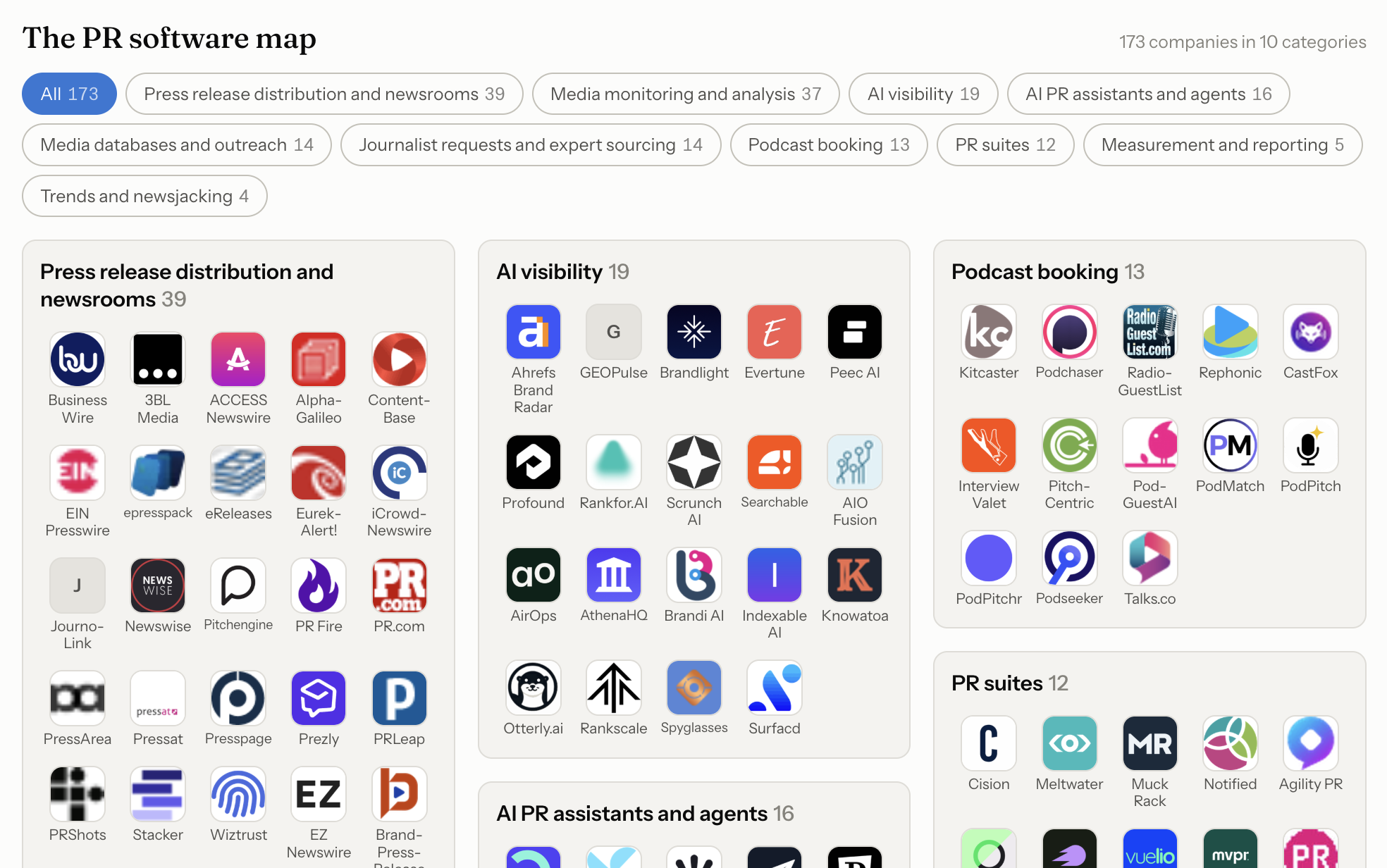
There are now nearly 150 companies (the actual number is 143) that sell AI tools (see also: SaaS, remember that?) for PR professionals, and they can be distilled into four categories:
Discover
Search
Pitch
Measure
Many of the ‘big name’ PR tools, such as Cision, Meltwater, Muck Rack, and LexisNexis, fall into multiple categories. But, there are also plenty of fun, newer tools that I haven’t heard of (and maybe you haven’t, either) but that I plan to check out.
One thing you should know about me? I love fun little tools and hacks. I’ll work on an edition reviewing a few new tools in each category soon.
Check out the PR Software Map here.
The High: Nespresso 🤝 Strava
Earlier this month, Nespresso and Strava announced a brand partnership ahead of the Chicago and New York City Marathons. The partnership will “reward Strava users who commit to personal wellness rituals throughout the campaign with to-be-announced prizes.”
This is a partnership made in runner heaven and, according to Nespresso, is coming as a way to integrate the coffee brand more into the lives of Gen Z, who are drinking less coffee than their predecessors. These integrated advertising campaigns are essential for advertisers right now because they are less about blasting your target audience with ads everywhere they look and more about showing up in different (appropriate) areas of their lives where your product or service is actually meaningful and/or relevant.
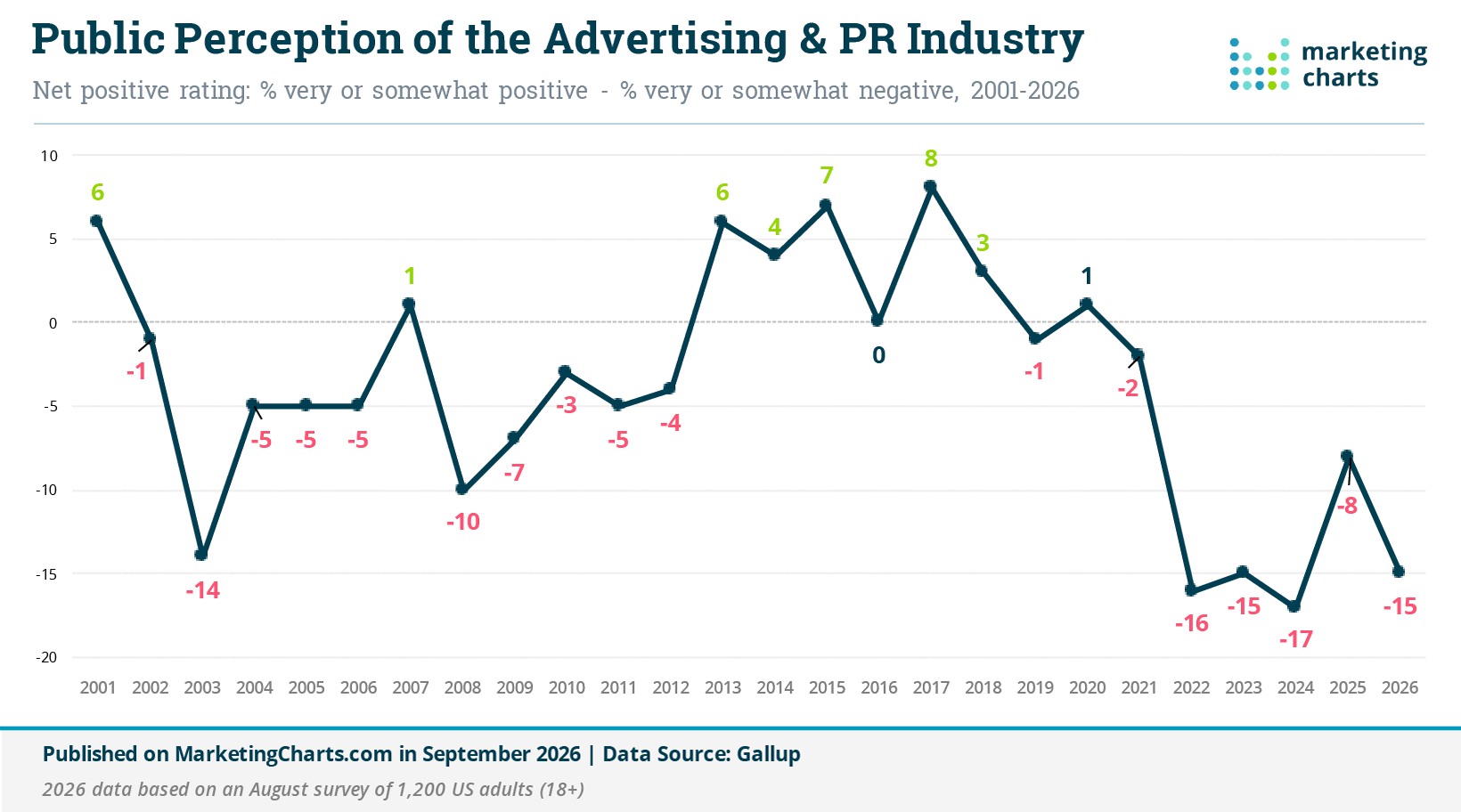
A chart from MarketingCharts.com showing public perceptions of the advertising & PR industry over time.
Wondering why? Well, people are sick of ads. According to MarketingCharts, public sentiment toward the Advertising & PR Industry is at a shocking low—only 26% of U.S. adults have an overall view of the industry that is either very (8%) or somewhat (18%) positive. That’s a lower rating than the Oil & Gas and Pharmaceutical industries, for context.
As an aside, there’s a quote in the article that explains the relationship between running and coffee, though I personally don’t need a briefing on that: When I was a runner at Shippensburg University of Pennsylvania, my coach and Olympic marathoner Steve Spence used to drink a gigantic coffee (or two) every day. I remember that detail specifically. And, a little caffeine boost before a run helps a lot—some gels even contain caffeine for use in-race.
As marathon season gets into full-swing, look out for more running related content from the Spry PR team. 😉
Read about the partnership between Strava and Nespresso here.
Like the sPRint? Share it with the rest of your team!
This is a 100% human-written newsletter (imagine that!). Be kind and share the marketing goodness here 👉 https://sprypr.co/newsletter-subscribe